Wednesday, 14 January 2015

Senator Warren and America Win in a Skirmish in a Long Struggle Against Wall Street’s Coup

There is an excellent indicator that Senator Warren’s successful effort to block the appointment of Antonio Weiss, an Obama Wall Street bundler, to a senior Treasury position while merely a skirmish was an important accomplishment. The financial media that pander most slavishly to the Wall Street and the City of London’s CEOs is enraged at Warren’s success. The headline in the UK’s Business Insider reveals their angst “Elizabeth Warren Wins, The Treasury Loses.” The article doesn’t try very hard to support that headline with facts because there is no real case to support the claim.
A number of former Treasury officials thought Warren was way out of line, and that Weiss’ experience was perfect for the position he was being nominated for. 
The White House stood by its nominee throughout, stating last month, “This is somebody who has very good knowledge of the way that the financial markets work, and that is critically important.” 
No argument on that here.
Let’s begin with logic. There’s no logical way to declare that “Treasury lost” without knowing who else is willing to take the position of Under Secretary for Domestic Finance. No one thinks President Obama selected Weiss on the merits. He was selected because he bundled Wall Street campaign contributions for Obama’s campaigns. Treasury does not “win” when we appoint such people – Wall Street wins. We have no way of knowing whether Obama will select someone for the position who is better or worse than Weiss. The Undersecretary position is prestigious enough that we know that Obama has the ability to appoint hundreds of people who would like to take the position and are better qualified than Weiss. As a matter of logic, therefore, the authors could not support their claim.

The authors also don’t seem to have felt they could even try to make a case for their claim. They simply quote authority rather than reasoning. Their effort unintentionally made Warren’s opponents look bad. Consider the extraordinary arrogance of the statement “A number of former Treasury officials thought Warren was way out of line.” A U.S. Senator who is a member of Treasury’s oversight committee is completely “in line” to oppose nominees. Warren obviously did not oppose Weiss for partisan reasons. She opposed him on the merits. Weiss does not have a strong background for the skill sets required for the Undersecretary position. Again, no one can claim with a straight face that Obama selected Weiss on the merits. Of course, the same thing was true of many of the Treasury officials who think it is “way out of line” for Senators not to rubberstamp political reward-style appointments of Wall Street bundlers.

The best that the White House could come up with was that Weiss “has very good knowledge of the way that the financial markets work.” That description fits about one million Americans.

Conclusion

Warren has given Obama a golden opportunity – a “do over.” Obama can appoint someone who has a “very good knowledge of the way that the financial markets work” – and a passion for changing how they work in order to end the Wall Street culture of corruption and create radically improved markets based on integrity and service to investors with radically reduced profits. Obama could pick someone good for America, not “Treasury” and its Wall Street overseers. It is “critically important” that the financial markets be restored to a condition in which they aid Main Street and small investors rather than acting as parasites and predators.

At this juncture, the White House is signaling its continued opposition to serious reform.
“‘We continue to believe that Mr. Weiss is an extremely well-qualified individual, who is committed to the policy goals of this Administration and firmly supports the Administration’s policies on fostering economic growth and supporting our middle class. We are pleased that he has accepted the role of counselor to the Treasury secretary.’”
The administration continues its policy of never missing an opportunity to miss an opportunity to openly side with the American people (all of them, not simply “our middle class”) and demand the end of the corrupt culture of Wall Street. Warren has given Obama a priceless opportunity for a “do over.” No one expects Obama to do the right thing on the appointment, but Warren is doing the right thing by giving Obama a new the chance to do the right thing.

Source

Tuesday, 13 January 2015

The Central Banks Still Appear To Be In Control (Or So They Think)

2015 has started much as 2014 left off which should come as no surprise as markets care little for arbitrary changes in dates after all; so no predictions! Oil is one of many unknown variables including the fate of Greece the strength of the dollar the flight of Abe's third arrow relations with Russia and the greater Chinese slow down. Then of course we have elections in the UK which will be interesting in the debate but almost certainly inconclusive in the outcome. It has been suggested a coalition government might be formed between Labour, the Scottish Nationals and UKIP; if so I'll be catching the first flight to somewhere a long way off.

The central banks still appear to be in control; well they seem to think so. Now he is no longer in that particular club Alan Greenspan thinks things look a bit "risky". Well risk is what investing is all about after all, but what is this elusive "particle" orbiting our portfolios?

Some would have you believe that it's all about volatility. If it goes up and down a lot the ride will be bumpy but you stand to make a lot more money than in something that gives you a smoother ride. Looking back over the last 30 years or so that smooth ride would have been government bonds and for most of that period returns would have been better than equities. So a low risk portfolio should be stuffed full of them right? Yes indeed if your risk model looks purely at long term historical data and ignores where we are in the journey.

But markets have an enormous propensity to make us look like fools. This time last year the predictors were saying, to a man, that sovereign debt was hugely expensive and due a very significant correction as rates were bound to rise weren't they? If there is one data series that is consistently called incorrectly this is it - perhaps a reason why the largest component of the derivatives mountain is in interest rate futures!

So in the UK a gilt tracker would have made you nearly 15% against a pretty much flat equity market and the 10 year gilt now resides at a scanty yield of 1.6%. Over in Europe the 10'year Bund is at 0.4% and everything under 5 years duration pays a negative yield. Yes investors are willing to pay a premium just to get their money back!

As the chart of the 10 year Treasury yield shows, we have come a long way in the interest rate journey and whilst further gains are possible can yields go much lower. If we are going Japanese, and the Germans already are, then of course they can. Ten years ago, having 50% in investment grade bonds in a portfolio for a cautious investor would have been eminently sensible especially with one’s attention in the rear view mirror, but today?

The major unintended consequence of government and central bank intervention since Volcker's stand against inflation has been to generate its nemesis; deflation. With interest rates near zero in the major economies, there is nowhere for rates intervention to go to provide a stimulus. Strangely the answer must be higher interest rates. We will then see some "creative destruction" which is what the financial system needs to reset and start a proper economic cycle, but with the investment banks, who stand to lose the most, controlling the strings (just how do you think the US Budget bill got changed to allow banks’ derivative positions to be included in subsidiaries covered by FDIC insurance? ie the taxpayer covers their losses) we need stronger hands at the tiller than a coalition of "politicians" or a lame duck president. We need somebody with balls and I don’t mean the second fiddle in the Ed Miller band... any volunteers?


Source

Monday, 12 January 2015

Citi, Goldman, ICAP And Others Prepare For Grexit... Again

Every couple of years the same identical European drill repeats itself: 1) Greece makes loud noises as it approaches an election, 2) Europe says it couldn't care what the outcome is and that Greece should stay in the Euro but if it exits it won't be a disaster, 3) the ECB reminds everyone of the lie that it is not preparing for Plan B (it is) despite holding on to over €100 billion in "credibility-crushing" Greek bonds, 4) panicking Greek banks say the deposit outflow situation is completely under control (adding that "The Bank of Greece along with the European Central Bank are monitoring closely the developments and intervene whenever this is necessary," which is code word for far more familiar, five-letter word), and meanwhile 5) all non-Greek banks quietly start preparing for the worst case scenario.

So far this time around, we had everything but step "5". We do now.

According to the WSJ, "banks and other financial institutions in Europe are stress-testing their internal systems and dusting off two-year-old contingency plans for the possibility Greece could leave the region’s monetary union after a key election later this month. Among the firms running through drills are Citigroup Inc., Goldman Sachs Group Inc. and brokerage ICAP PLC, according to people familiar with the matter."

And soon enough Bloomberg, because who can possibly forget the mysterious appearance of the "XGD Crncy" in June of 2012, only to disappear moments later after a few hurried phone calls from Frankfurt...

But back to the banks: "The firms’ plans include detailed checks on counterparties that could be significantly affected by a Greek exit, looking at credit exposures and testing how they would provide cross-border funding to local operations."
Some firms are also preparing for the impact on payment systems and conducting trial runs of currency-trading platforms to see how they would cope with adding a new Greek currency or dealing with potential capital controls.

The moves come as Greek leftist opposition party Syriza continues to lead in recent public opinion polls ahead of national elections on Jan. 25. The ruling coalition government has framed the election as a de facto poll on whether the country stays in the eurozone, saying Syriza’s antiausterity policies would force a break with eurozone partners. Syriza, though, hasn’t campaigned on an exit and most Greek voters want to stay in the monetary union, according to recent polls.
Summarizing Europe's only strategy for the past 5 years is Frederic Ponzo, managing partner at consultancy Grey Spark: "Hope for the best, plan for the worst."

At some European banks, that currently means dusting off plans drawn up a couple of years ago, when a eurozone breakup was a hot topic. In 2011 and 2012, banks, brokers and companies with significant exposure to Greek assets put in place contingency plans to minimize the fallout from a breakup.

Which is smart, because absolutely nothing has changed in Europe where not even "Mr. ECB Chairman got to work" but merely verbally hypnotized the bond vigilantes into a state of paralysis, and as a result, nothing at all has been fixed, aside from the idiotic low yields on European bonds all of which have been bought to ridiculous levels on what is now a 3 years frontrunning of an ECB action that has been three years in the coming, and which many say will never actually arrive: the outright - and illegal according to Article 123 - monetization of European sovereign debt across the board.

It goes without saying that should the worst case scenario take place, the immediate question is who is next, and will the "XIL" be the next ticker everyone eagerly awaits:
The head of currencies trading at a large European bank said that reintroducing the Greek drachma to its trading system wouldn’t be too difficult, but dealing with a larger breakup would be more challenging.

“Italy could follow Greece’s steps if the exit will prove successful in providing some relief to the country’s economic crisis,” he said.
Italy... or Spain. Earlier today we got news that Spain's own equivalent of Syriza is surging in the polls and has left the ruling socialist party in the dust: "A poll published on Sunday showed that leftist up start Podemos was again in the lead to winSpain's next general election, which could result in the formation of party pacts, or even the country's first coalition government."
The Metroscopia poll of 1000 people, published in the left-leaning newspaper El Pais, showed one-year-old Podemos (We Can) would take 28.2 percent of the vote, up from 25 percent in December when it fell back to second place behind the Socialists. Podemos stood at 10.7 percent of the vote when it was first included last August.
So assuming Europe survives the Greek election in 2 weeks it has a Spanish redux to look forward to in less than 12 months:
Spain has a general election due by the end of the year and a regional and municipal election expected in May. Most of those who told Metroscopia they would vote for Podemos said they believed Spain needed to get rid of its two-party system.
If only Americans shared the same sentiment.

And yet while democracy has always been the Achilles heel in Europe's artificial political and monetary construct which works in an ideal world dominated by technocrats, it is not even the Greek, or Spanish, elections that may be the biggest risk.

As Reuters also reminds us, a "landmark" legal opinion this week will remind the European Central Bank as soon as Wednesday of the limits it faces as it advances towards money printing. With expectations high that the ECB is on the verge of buying government bonds with new money to shore up the economy, an influential adviser to Europe's top court will give his view on Jan. 14 about an earlier unused bond-buying scheme.
"It is the latest chapter in a long-running and increasingly bitter dispute about quantitative easing (QE) between the ECB and Germany, the largest member of the 19-country bloc, that is likely to limit the size or scope of such a program. As the debate continues, the euro zone economy is all but grinding to a halt. Germany is expected to announce modest growth on Jan. 15 for last year."
Here is how SocGen summarizes the threats from just the European Court of Justice decision this week, and its potential downstream affects:
“Whatever it takes”. This was the promise made by ECB President Draghi on 26 July 2012 and cemented by the OMT on 6 September 2012. Since then, market participants have placed their faith in this promise. On 12 September 2012, the German Federal Constitutional Court (GFCC) announced it would examine whether the OMT is an ultra vires act stretching beyond the limits established by the German Act approving the ESM (link to decision here).

A still lengthy process ahead, but the GFCC will have the final say: Fast forward to 7 February 2014 when the GFCC delivered its decision on the OMT (link here), referring the case to the European Court of Justice (ECJ) for a preliminary ruling (for more on the  process click here), but maintaining that in case of an ultra vires act, the GFCC is competent to rule on the constitutionality of the OMT. The next key date is 14 January, when Advocate General Cruz Villalón delivers his opinion in the case (link to ECJ proceedings here). A final ruling from the ECJ will follow only months later, and the Advocate General’s opinion does not have to be followed. Only then will the GFCC give its final ruling and it may, by then, well be 2016.

If the OMT is not adapted, the GFCC is very likely to reject it: The GFCC decision already concluded that the OMT in its current form exceeds the ECB’s mandate, by encroaching upon the responsibility of the Member States for economic policy, and by being incompatible with the prohibition of monetary financing. The GFCC also suggested a possible interpretation in conformity with Union Law. In essence, it identifies three points to address.

1. Introduce a maximum limit on OMT purchases: In presenting OMT, the ECB declared it “unlimited”. In statements submitted to the GFCC, however, the ECB noted that given that OMT can only buy debt with a maturity of up to 3 years, this de facto sets a maximum of €524bn (for Italy, Spain, Portugal and Ireland). The GFCC is nonetheless concerned that this “implicit” limitation could easily be circumvented by increased sovereign issuance on shorter maturities. 

SG view: Introducing an explicit limit on the potential size of OMT is likely to address  GFCC concerns on “unlimited”. A limit of €500bn is, in our opinion, unlikely to trigger significant market concerns as this would still leave the OMT well armed to offer targeted support to a member states under an eventual ESM program. 

2. Set a locking period around issuance: The GFCC flagged the potentially blurred line between purchases in primary and secondary markets. The former is prohibited under the Treaty while the latter is allowed. In its statements, the ECB noted that a locking period will be determined in a guideline, but not published. 

SG view: A clear commitment to a locking period should suffice on this point. 

3. Limit pari passu: A key strength of OMT is the promise to be pari passu with private investors in the event of a debt restructuring. In its statements to the GFCC, the ECB claimed that liability risk to national budgets is minimised by sufficient risk prevention, but added that should losses nonetheless occur they could be carried forward and balanced with revenues in the following years. The Bundesbank in its statements disagreed, noting every loss that it incurs burdens the German federal budget. The GFCC support this view highlighting that “the possibility of a debt cut must be excluded”.

SG view: To our minds, the pari passu status of the OMT is unlikely to survive the various court proceedings, marking a blow to Draghi’s “whatever it takes” promise and increasing loss-given-default for private investors. Note, that the decision by the GFCC on the ESM excludes the possibility of the ESM assuming OMT credit risk as this would de facto leverage the mechanism. To change this, the ESM Treaty would need to be renegotiated, with all the complications that this would entail.

Somewhat surprisingly, the GFCC decision had essentially no market impact when it was released back in February. Market faith in euro area government’s efforts to deliver growth and sustainable public finances offers one possible explanation. Given significant fears on sustained lowflation, we believe that more recently it is the promise of a large sovereign QE program that offers support to market confidence.
None of the above is even remotely influenced by the subsequent Greek elections and the ECB's potential QE announcement on January 22 (which SocGen summarizes as follows: "QE unlikely to be both large scale and pari passu").

For simplicity's sake, here is the full calendar of risk events in just the next 2 weeks, any single one of which has the potential to send the market soaring... or crashing.

Source

Friday, 9 January 2015

The CBO’s Bad Math: Putting $7 Trillion of Notional Value of Derivatives in Taxpayer-Backstopped Depositaries Will Cost Zero

So why did Elizabeth Warren lose her battle last month to stop banks from continuing to park $7 trillion notional value of risky derivatives like the credit defaults swaps in taxpayer-backstopped depositaries?

One of the less well-recognized reasons is that the CBO’s dubious analysis said it would not cost taxpayers a dime.

The Congressional Budget Office forecasts have enormous clout on the Hill. Yet as we’ve written, one of its most influential analyses, that of projected Medicare cost increases, was so rancid that two fiscal budgeting experts from the Fed roused themselves to write a lengthy academic paper demolishing it. That CBO work was so problematic on so many fronts, including that it violated CBO policies for the preparation of long-term forecasts in multiple ways, that it raises questions as to the intellectual honesty of the exercise.

In the case of the so-called swaps pushout rule analysis, the CBO came to a similarly dubious conclusion. We’ve embedded a report from the House Committee on Financial Services, which includes the CBO’s budget estimate on pages 5-6. The key bit is that “any impact on the cash flows of the Federal Reserve or the FDIC over the next 10 years would not be significant.” In budgetary terms, that is tantamount to saying it will have no cost.

This is absurd on multiple levels. There is an obvious subsidy to the banks here, otherwise Jamie Dimon would not have been lobbying personally to get the bill passed. FDIC insurance is widely acknowledged by banking experts to be underpriced, so increasing the risk held in depositaries, particularly of positions can and do go boom, makes the odds of going though the FDIC’s kitty even greater.

The CBO attributes no value to the de facto guarantee of these positions, despite the glaring contrary evidence of the $750 billion TARP in 2008 and a bailout of S&Ls in the early 1990s. Do they really have such a good crystal ball that their forecast period will manage to miss entirely one of our periodic banking system implosions? Trust me, if we have a meltdown, these positions will add to the cost. And with the Fed unlikely to be able to end ZIRP any time soon, it have less ability to use monetary tricks to levitate asset prices and thus reduce the fiscal costs of any salvage operation.

A post earlier this week by Occupy Wall Street’s Alternative Banking Group reminds us of how the last bank bailouts similarly undervalued the guarantees:
…even if we accepted the Treasury’s accounting and treated it like just another private trader, its returns are abysmal…it can’t properly count how much aid it gave — and continues to give — these businesses. Beyond the $426 billion of actual capital acquisitions the Treasury made, it provided guarantees and other support to these industries that experts have valued at more like $9 trillion. Calculate the $15 billion profit the Treasury is now bragging about using a $9 trillion base as the money that was put at risk and you start calculating minuscule returns like the 0.1 percent you’d see in a Chase money market. 
The fact that the Treasury did not have to make good on its promises to cover trillions of dollars of potential losses the financial industry had recklessly exposed itself to doesn’t mean the government did not give something of huge value. The mere fact of the government stepping in as a guarantor of things like toxic mortgage-backed securities kept the bank shareholders from being wiped out. This happened a lot as part of the bailout. But on Wall Street you can be sure to get paid for taking risks, regardless of whether the bad stuff you are insuring against happens. The Treasury, on the other hand, got paid basically nothing by putting all that taxpayer money on the line.
Let us not forget that Treasury conveniently omits a $35 billion of what Andrew Ross Sorkin called a “a tax benefit, er, gift, from the United States government.” So even on the raw numbers the “TARP made a profit” is questionable. And that’s before you get to three card monte, that the massive, ongoing subsidy to the banks via QE and ZIRP that goosed asset prices was essential to the Treasury being able to exit the TARP at all.

As derivatives expert Satyajit Das observed drily by e-mail:
The cost-benefit rationale is fascinating. I am impressed that people have determined enacting this legislation could affect direct spending and revenues; albeit not significantly. I would have thought not having to potentially bail out a depositary institution would have been a positive to public finances, not a negative. Clearly, I have been misinformed about how cost benefit analysis is done. 
It is an Alice in Wonderland view of markets.
Source 

Thursday, 8 January 2015

Fed Holds Fire on Disinflation Threat

The US Federal Reserve released its minutes from the December FOMC meeting just a few hours ago AEDST time (available here). The reaction on the markets has been mixed, whereas the pundits are chewing at the bit for signs of where the Fed shall strike next, with any rate rises put off until at least April.


Adam Button at ForexLive has the sceptical take on inflation:

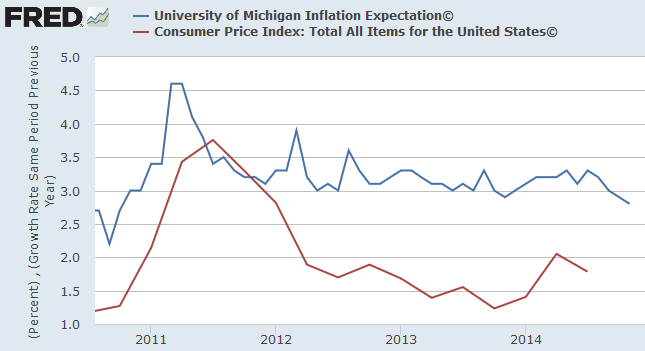
U-Mich-vs-reality

The FOMC minutes show a total disregard for the signals markets are sending about disinflation. Five year breakeven rates are plunging, implying that 1.09% average inflation over that period. 
The Fed discussed this problem of signaling rate hikes while the market signals disinflation in the Dec 16-17 FOMC minutes and had this to say. 
Instead of listening to the market. The Fed decided to listen to its models — the same kinds of models that assumed house price declines wouldn’t happen or be limited. On top of that, Yellen specifically mentioned the University of Michigan survey on inflation expectations, which has overestimated inflation by 200 basis points for the past three years.
This hearing disorder probably has grown out of an optimism condition, with most members dismissing any external risks, e.g deflation in Europe or fallout from the oil price collapse, with most betting on the ECB and others “doing something”, although some saw downside risks if “foreign policy responses were insufficient”.

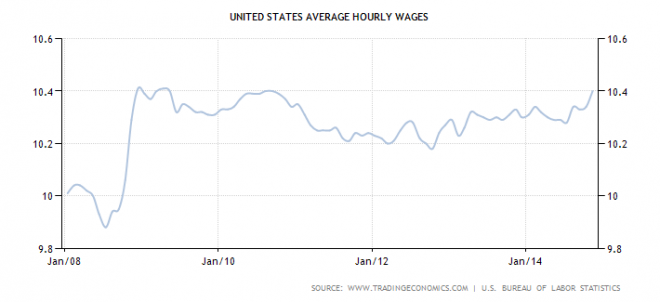
The question of rate rises by the Fed is being pushed out further and further, with the key point raised but not yet widely analysed is the lack of any acceleration in wages, although the huge relief from oil halving is sure to have an impact on disposable income. Wages have finally recovered from the GFC low:

united-states-wages


Whether this filters through to inflation is hard to gauge, which is stubbornly staying at or below 2% with core inflation slipping.

I would suggest unless this changes – and forward looking breakevens and the yield curve indicate no such change for a long time – rate rises will be off the table for a long, long time.

Source


Wednesday, 7 January 2015

Despite Current Glut, Oil Producers Continue Game of Chicken

When the world gives you too much oil, drill for more.

That seems to be the motto of some of the most prolific oil producers today. Iraq, Russia, Latin America, West Africa, the United States, Canada – all may increase production this year, and by more than just balancing out the reduced production in war-torn Libya. On top of this, expect even more oil on the market if Iran comes to terms with the West over its nuclear program and is freed of the constraints of sanctions.

That’s the conclusion of Adam Longson, an oil analyst at Morgan Stanley writing in an e-mailed report on Jan. 5.

All this new oil is flooding a market already awash because OPEC has refused to cut its production cap below 30 million barrels a day – and is even exceeding that level – and the United States is pumping oil, mostly from shale, faster than it has in 30 years. This has caused the average price of oil to plunge more than 50 percent, from about $115 in June 2014 to just over $50 today.

This is creating an unmitigated bear market for oil, according to Morgan Stanley. “With the global oil market just passing peak runs and Libyan supply already at low levels, it’s hard to see much improvement in oil fundamentals near term,” its report said. “A number of worrying signs have already emerged, lifting the probability of our ‘bear’ case.”

One more sign is that Iraq’s production is at its highest level in more than three decades, now that Baghdad has finally reached agreement with Kurdistan to allow it to export oil through Turkey. And just before the New Year there were reports that Russian oil output has hit post-Soviet records without any sign of abating.

“We already have an ample supply of oil, and on top of that we see this increase from Iraq and Russia,” Michael Hewson, analyst at CMC Markets, a British financial derivatives dealer, told The Wall Street Journal. “The momentum clearly continues to be bearish for oil.”

But wait, there’s more, according to the Morgan Stanley analysis. It says to expect increased production at several oil fields in Brazil, Canada, the United States and in West Africa. And, 
according to Hewson, there’s no sign of increased demand, according to reports of anemic economies in China and Europe.

And then there’s the environment. The governments of many countries – including the world’s two hungriest fossil fuel consumers, China and the United States – are striving to meet various targets for lower greenhouse gas emissions. This new green approach is responsible for “anemic global growth” in demand for oil and an “upsurge in competing supply,” said David Hufton, the CEO of the broker PVM.

“[It] is very plain for all to see that oil supply growth exceeds oil demand growth and from an oil producer point of view, this imbalance has to be rectified,” Hufton told the Financial Times.

Carsten Fritsch, a senior oil and commodities analyst at Commerzbank in Frankfurt, agreed. “The easiest path for oil is down,” he told Reuters. “Almost all market news and the fundamental backdrop are negative, and it is difficult to see much upside at the moment.”

Source

Tuesday, 6 January 2015

Stock Exchange Head: Fix Capitalism by Changing the Way Companies Are Funded

How can we make capitalism more popular? Individual investors should have access to tech start-up IPOs, giving the public a stake in capitalism, says Xavier Rolet, the chief executive of the London Stock Exchange ... Capitalism has taken a pummeling over the last few years. From the global credit crunch to the banking failures, the mis-selling of payment protection insurance (PPI) and beyond, popular faith in capitalism has been deeply shaken. – UK Telegraph

Dominant Social Theme: Capitalism is misunderstood. If we tinker with it, people may "get it."

Free-Market Analysis: The best way to make sure capitalism becomes more popular is to give people the opportunity to take a bigger stake in it.

That's the argument of the head of the London Stock Exchange, Xavier Rolet. He's not only convinced of capitalism's benefits; he also believes that capitalism can lift people out of poverty in a short period of time.

Here's more:

Few would argue that any other form of economic stewardship has ever created wealth and prosperity on a comparable scale: just ask any of the 400m Chinese people lifted out of poverty in the last decade.

What irks us about capitalism is not wealth creation but the brutality of its "boom-bust" cycles and the concentration of wealth "at the top". Can a more popular capitalism soften these sharp edges?

We do not seem to have learnt much from the past few hundred years of capitalist history. Every major crisis has had the same root cause: our inability to monitor, manage and control leverage in the banking industry.

At times, taxpayers have been asked to rescue some of these financial institutions, but many would be surprised to learn that most European countries continue to subsidise leverage in the financial sector through the deductibility of interest.

Certainly debt has an important role to play as an accelerator of GDP growth.

But imagine a fiscal regime where deductibility of interest would cease above a certain maximum leverage ratio. Would banking institutions ever again leverage up as much as some did in 2008, so that a swing of just a few percentage points in the value of banks' balance sheets would completely wipe out their equity? It seems unlikely.

We need to move away from seeing bank lending as a panacea. Banks have been dealt an impossible hand – they face enormous pressure to increase lending but also tough and increasingly complex new rules on regulatory capital and leverage ratios.

The author is certainly correct that banks have an "impossible hand" to play. But isn't that the result of regulatory pressure and central bank asset inflation? The first constrains banks from implementing a variety of defensive strategies and the second whipsaws banks with surges of inflationary depressions.

For Rolet, this cyclical destruction is apparently not inevitable. He goes on to suggest an alternative form of industrial funding based on initial equity participation, as follows:

If we are to reconcile citizens with capitalism, we must offer them a stake, facilitating individual investor access to this new wave of world-class UK tech start-ups. We should look to reinstate the retail tranche for IPOs, which contributed to the success of the privatisations of the Eighties. Abolished in the Nineties, it should be redesigned to give entrepreneurs the option to earmark a percentage of their IPOs for the investing public.

The problem with this suggestion, from our point of view, is that central bank money surges are immutable. They wax and wane as steadily as the tide and are not subject to moderation based on structural changes affecting transactions.

Rolet is like a medical technician, suggesting ways a patient's pulmonary system can be revived after a heart attack. But the underlying problem, the one that caused the initial embolism, remains unaddressed.

His "solution" doesn't deal with capitalism's unspoken flaws: monopoly money printing and corporate personhood. And thus his admiration for capitalism as a free-market phenomenon ought to be tempered, too. (Apparently, it's not.)

Capitalism as it operates in the 21st century is bound by critical court decisions that affect economies around the world. Each economy that partakes of modern capitalism also accepts its artificial constraints – restrictions enforced by the state itself involving its fundamental corporate and banking pillars.

Rolet writes:

We must rediscover a form of popular capitalism that works for us all, rather than a gilded fraction of society. One that is built upon competitive but ethical practices, innovation, entrepreneurship and the notion that risk-taking and success are good things.

This is an optimistic comment, indeed. Merely legalizing an additional funding source is surely not going to make the fundamental change that Rolet seeks. So long as central banks have monopoly money powers to generate unnecessary surges of money, so long as multinational corporations grow unrestrained thanks to the corporate personhood that shields executive from personality culpability, capitalism's boom-bust paradigm will remain unchecked.

Rolet concludes:

Distributing risk capital directly at the bottom of the entrepreneurial ladder rather than debt from the top via a handful of lenders will create a more sharing capitalism, with the corollary benefits of a less debt-dependent, less bankruptcy-prone and less fragile economic cycle.

This is simply incorrect. It cannot be correct. So long as interest rates are held artificially low, boom-bust cycles will continue to plague capitalism. As no one really knows the "natural rate" of an economy's operation, it is very difficult for bankers to set interest rates at a "proper" level. They don't have the forward-looking tools to do it.

This combined with newer methods of monetary stimulation such as quantitative easing virtually guarantee that economies will be regularly over-stimulated via rates set toward the zero-bound.

Conclusion: 
Rolet's points would make more sense if he addressed the reality of capitalism's monopoly structure and dirigisme before suggesting solutions to address a "free-market" that does not exist.

Source